For healthy lettuce, kale, spinach, basil, and chard in a deep water culture bucket, the simplest General Hydroponics Flora trio dosing for leafy greens in DWC follows a low-EC, nitrogen-forward ratio: roughly 1 mL FloraMicro, 2 mL FloraGro, and 1 mL FloraBloom per gallon of reservoir water during seedling and early vegetative growth, climbing to 2-4-2 mL/gal once true leaves expand. Target an EC of 0.8-1.4 mS/cm and a pH of 5.6-6.0, top off with plain pH-adjusted water between full reservoir changes every 7-10 days, and you will get crisp, fast leaves without tip burn or bolting.
This guide walks through the full Flora Series schedule for leafy greens grown in DWC totes and bucket systems, plus EC targets by growth stage, temperature corrections, the order of mixing (which actually matters), and the small gear list that keeps the program on rails.
Why the Flora Series Works So Well for DWC Leafy Greens
General Hydroponics Flora Series is a three-part liquid concentrate (FloraMicro, FloraGro, FloraBloom) designed so growers can shift the N-P-K ratio by adjusting the proportions of the three bottles. Leafy greens want plenty of nitrogen and calcium and very little phosphorus or potassium spike, so a heavier FloraGro and a moderate FloraMicro pour, with just enough FloraBloom to keep magnesium and sulfur balanced, gives you a clean, leaf-forward profile.
The trio also dissolves cleanly in oxygen-rich DWC reservoirs, doesn't crash pH the way some single-part synthetics do, and produces almost no sediment that could foul air stones. That combination is why dialed-in General Hydroponics Flora trio dosing for leafy greens in DWC remains one of the most copied recipes in the hobby a decade after the bottles first hit shelves.
The Dosing Schedule (Per Gallon of Reservoir Water)
The numbers below assume RO or soft tap water under 150 ppm starting EC. If your tap is harder, drop each dose by about 25% and let measured EC be the final judge.
| Stage | FloraMicro | FloraGro | FloraBloom | Target EC | Target pH |
|---|---|---|---|---|---|
| Seedling / Cotyledon (Days 1-7) | 0.5 mL | 0.5 mL | 0.5 mL | 0.4-0.6 | 5.8 |
| Early Veg / 2-4 True Leaves | 1 mL | 2 mL | 1 mL | 0.8-1.0 | 5.8 |
| Active Veg / Cupping Heads | 2 mL | 4 mL | 2 mL | 1.2-1.4 | 5.6-5.8 |
| Pre-Harvest (final 5-7 days) | 1.5 mL | 3 mL | 1.5 mL | 1.0-1.2 | 5.8-6.0 |
| Flush (final 24-48 h, optional) | 0 | 0 | 0 | Plain pH 6.0 water | 6.0 |
Note the consistent 1-2-1 ratio. Cannabis growers running the same bottles use 3-2-1 in veg and flip to 1-2-3 in bloom; leafy green growers do not flip. Lettuce and kale never enter a flowering stage you care about - in fact, the entire goal is to harvest before bolting, so you stay in a veg-style ratio from transplant to cut.
Mixing Order Matters
The Flora Series is famous for one quirk: if you pour the bottles in the wrong order, calcium and phosphate precipitate and form a milky lockout. Always add to the reservoir in this sequence, stirring between each:
- FloraMicro first - it carries the calcium and chelated micros, and must be diluted before phosphate or sulfate hits it.
- FloraGro second - the nitrogen and potassium workhorse.
- FloraBloom last - phosphorus, magnesium, and sulfur.
Stir for 15-30 seconds after each bottle. Then check and adjust pH. Never pre-mix the three concentrates in a jug; the precipitate forms instantly at full strength.
EC, pH, and Temperature: The Three Knobs You Actually Turn
The recipe above is a starting point. Real plants respond to your specific water, lights, and room temperature. Three measurements tell you whether to nudge the schedule up or down.
EC / PPM
Leafy greens are light feeders. Above EC 1.6 (about 800 ppm on the 500 scale), lettuce edges crisp brown and basil leaves curl. Below EC 0.6, lower leaves pale and growth stalls. Measure every time you top off, and add a half-dose of trio whenever EC drifts more than 0.2 below target.
pH
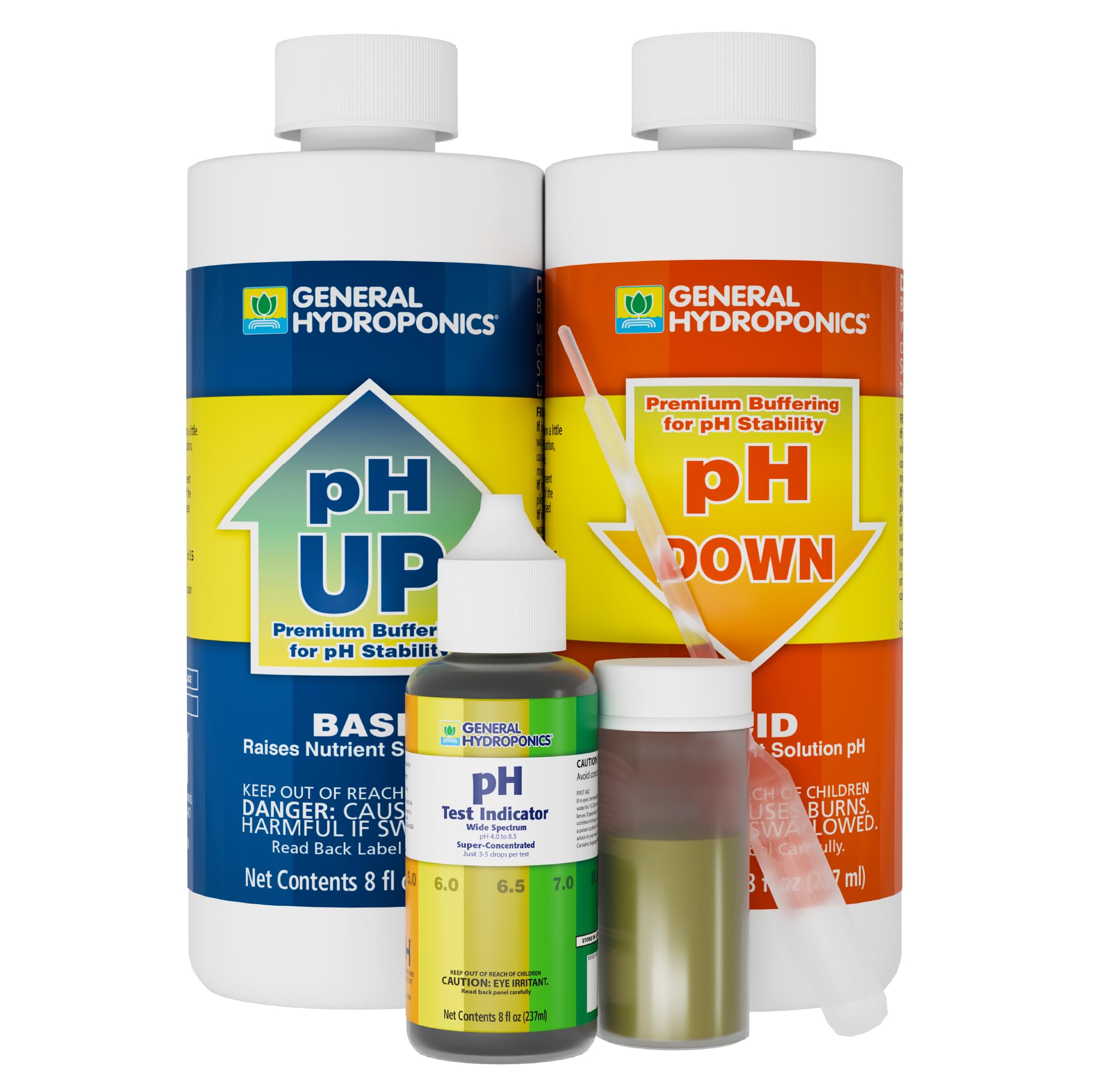
DWC pH naturally creeps up as plants drink. Adjust with GH pH Down (phosphoric acid) in small splashes - 0.5 mL per 5 gallons moves a typical reservoir about 0.3 points. Anything between 5.5 and 6.2 is acceptable; 5.8 is the sweet spot for calcium and iron uptake.
Reservoir Temperature
This is the silent killer of DWC leafy greens. Above 72 °F (22 °C), dissolved oxygen drops and Pythium root rot becomes likely. Aim for 65-68 °F. A frozen water bottle floated in the reservoir twice a day works for small builds; larger systems benefit from a 1/10 HP chiller.
Top-Offs vs. Full Reservoir Changes
Plants drink water faster than they consume nutrients, so a topped-off reservoir slowly concentrates salts. The rhythm that works for most home DWC setups:
- Daily: check water level, top off with pH-adjusted plain water if EC is above target, or with quarter-strength nutrient solution if EC is below target.
- Every 7-10 days: dump the entire reservoir, wipe the bucket, and refill with a fresh full-strength mix.
- Anytime EC drifts more than 0.4 in either direction: change the reservoir early. Drift means the plant is selectively pulling certain ions and the ratio is no longer what you mixed.
Optional Additives That Actually Help Leafy Greens
The base trio covers everything mature lettuce needs, but two GH supplements earn their shelf space in a DWC reservoir focused on leaves:
- CALiMAGic (1-2 mL/gal) - adds calcium and magnesium when running RO water. Tipburn on romaine almost always traces back to calcium delivery, and a small CALiMAGic dose fixes it.
- RapidStart or Diamond Nectar (0.5 mL/gal) - fulvic acids and root stimulators that speed transplant recovery from rockwool or peat plug into the net cup.
Skip the bloom boosters, PK spikes, and ripeners. They are formulated for fruiting crops and will push lettuce into bolting and basil into early flowering, which collapses leaf flavor.
A Sample 28-Day Lettuce Run
Here is what the schedule looks like end-to-end for a head of butterhead lettuce in a 5-gallon DWC bucket under a 100-watt LED:
- Days 1-7 (transplant): 0.5-0.5-0.5 mL/gal trio + 1 mL/gal CALiMAGic. EC 0.5, pH 5.8.
- Days 8-14 (rooting out): bump to 1-2-1 mL/gal. EC 0.9. Top off daily.
- Days 15-24 (heading up): 2-4-2 mL/gal. EC 1.3. Full reservoir change on Day 15 and Day 22.
- Days 25-28 (pre-harvest): dial back to 1.5-3-1.5 mL/gal. EC 1.1.
- Day 28: harvest in the morning when leaves are turgid and sugar levels peak.
Basil follows the same curve but happily takes EC 1.4 once mature. Kale and chard prefer the upper end of the EC range from Day 15 onward and tolerate slightly warmer reservoirs.
Troubleshooting Common Issues
Yellowing Lower Leaves
Almost always nitrogen drift after a long top-off cycle. Change the reservoir and confirm EC is at target. If yellowing persists, check pH - above 6.5, iron and nitrogen lock out together.
Brown Leaf Tips (Tipburn)
Calcium mobility issue. Add CALiMAGic, lower reservoir temperature, and increase airflow over the canopy so transpiration carries calcium to leaf edges.
Slimy Brown Roots
Root rot from warm, low-oxygen water. Drop reservoir temperature below 68 °F, increase air stone output, and consider hydrogen peroxide (3 mL of 3% solution per gallon) as an emergency oxygen boost while you fix the underlying temperature problem. For more prevention tactics see our guide to maintaining a hydroponic system.
Bolting (Premature Flowering)
Triggered by heat and long photoperiods more than nutrients. Keep room temperature under 75 °F and run lights no more than 14-16 hours for lettuce. Even perfect General Hydroponics Flora trio dosing for leafy greens in DWC cannot rescue a 28 °C grow tent.
Gear That Makes the Schedule Easy
You only need three categories of supporting tools to run this program reliably: an accurate EC/pH meter, a calibrated syringe or graduated cylinder for the bottles, and a quiet air pump with enough output to keep dissolved oxygen above 6 ppm. Our team's current picks live in the best pH and EC meters for 2026 and best indoor plant nutrients of 2026, both of which include budget options under $40.
If you are still choosing a system, our NFT vs DWC comparison walks through why DWC tends to win for home leafy-green growers who want low maintenance and forgiving nutrient management.
Frequently Asked Questions
Can I use the GH Flora trio for lettuce in a Kratky jar without an air pump?
Yes - the dosing schedule is identical, but start at the seedling EC of 0.5 and never go above EC 1.0 because there is no top-off and the solution will concentrate as the plant drinks. Harvest before the roots are fully exposed to avoid suffocation.
What EC and PPM should I target for basil in DWC?
Basil happily takes EC 1.2-1.4 (about 600-700 ppm on the 500 scale) once it has four sets of true leaves. Below EC 0.9 the leaves go pale; above EC 1.6 the essential oil profile turns harsh.
Do I need CALiMAGic with the Flora Series for leafy greens?
Only if your source water is RO, distilled, or very soft tap below 60 ppm. Hard tap water already supplies enough calcium and magnesium that adding CALiMAGic can push EC too high and cause antagonism with potassium uptake.
How often should I change the DWC reservoir when growing kale?
Every 7-10 days for full-strength changes, with daily top-offs. Kale is a heavier feeder than lettuce, so its EC will drift faster - if you see a 0.3 drop within three days, change the reservoir on Day 5 instead.
What pH range is best for spinach in DWC with the Flora trio?
Spinach prefers a slightly higher pH than lettuce, around 6.0-6.5, because it absorbs iron and manganese better in that range. Keep EC moderate at 1.0-1.2 to prevent the leathery texture that high-EC spinach develops.
Can I switch from Flora trio to MaxiGro mid-cycle?
Yes, but do a full reservoir change rather than mixing the two product lines in the same tank. MaxiGro is a one-part dry powder with a different chelate package, and combining concentrates often shifts pH unpredictably.
How long does an opened bottle of FloraMicro last?
Roughly two years if you keep it sealed, away from direct sunlight, and below 75 °F. Crystallization at the bottom is normal in cold storage - warm the bottle to room temperature and shake before measuring.
Final Thoughts
Dialed-in DWC leafy greens are arguably the easiest hydroponic crop on the planet once you stop overthinking the nutrient line. A 1-2-1 ratio of the Flora trio, EC under 1.4, pH near 5.8, and a cool, well-aerated reservoir will outperform almost any premium leafy-green-specific product on the market. Start at the seedling dose, climb stage by stage, and trust your EC meter over any chart - including this one. For broader context on building out your setup, our ultimate guide to hydroponics for home gardeners covers the systems, lighting, and environmental controls that make this nutrient schedule shine.
Key Takeaways
- Choosing the right General Hydroponics Flora trio dosing for leafy greens in DWC means matching capacity and output ports to your actual devices
- Always check actual watt-hours (Wh), not just watts — runtime depends on Wh, not peak output
- Also covers: Flora Series feeding chart lettuce
- Also covers: DWC nutrient ratios leafy greens
- Also covers: FloraGro FloraMicro FloraBloom lettuce
- Compare price-per-Wh across models to find the best value for your budget